
Pornichet’s Belle Époque villas
You come across them as you walk up the avenues of Sainte-Marguerite, the town centre or the railway station district: ornate façades, sculpted friezes, balconies facing the Atlantic. Pornichet’s villas are not simply houses. They are witnesses to an era when artists, entrepreneurs and Parisian personalities came to set down their luggage by the ocean — and build their dreams in stone, granite and wood.

Art Nouveau and Art Deco on the façades of Pornichet
They are often confused. Yet Art Nouveau and Art Deco can be told apart at a glance, once you know where to look.
Art Nouveau emerged in the late 19th century, during the Belle Époque. It drew its inspiration from nature: plant-like curves, arabesques, floral motifs and flowing lines that seem to grow across façades like ivy on a wall. In France, the movement is famously embodied by Hector Guimard’s Paris Métro entrances and Émile Gallé’s glasswork in Nancy.
Art Deco came later, after the First World War, in the spirit of the 1920s. Curves gave way to geometry, symmetry and cleaner lines. The style was officially born at the 1925 International Exhibition of Decorative Arts in Paris. It embraced industrialisation, using steel, aluminium and concrete.
In Pornichet, the two architectural languages live side by side. Walking through Sainte-Marguerite, you can spot villas with ornate balconies, floral friezes and Art Nouveau finials. Further along, the Casino displays sharper, more streamlined Art Deco lines. Two eras, two aesthetics, one shared seafront.
The villas that shaped Pornichet
Behind every façade lies a name, an era, an adventure.
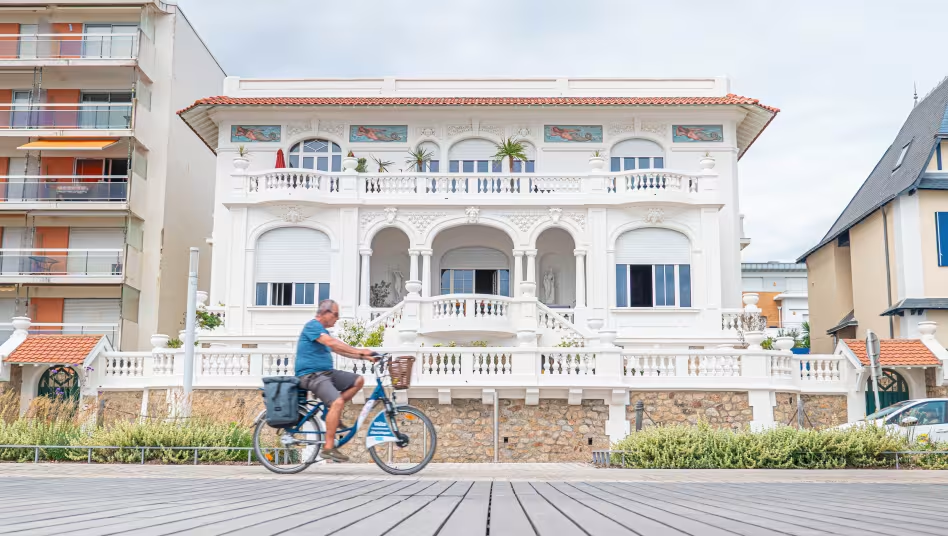
Ker Souveraine, on the seafront boulevard, has been the only villa in Pornichet listed on the supplementary inventory of Historic Monuments since 2002. Built in 1925 for Suzanne De La Noue, a strong-willed Parisian woman, it is Mediterranean in style. An immaculate exterior, friezes adorned with mermaids sculpted by the plaster artist Karkovic, and an eclectic interior: a Chinese bedroom, an Art Deco bathroom, faux-marble colonnades. It is said that the mascaron on the façade bears the features of its owner. When it was built, the villa stood directly on the beach, before the seafront boulevard was laid out in 1929.
Ker Bon Accueil is now the town hall. Its story began in 1910 when Mr Vigner, a building contractor from Saint-Nazaire who made his fortune developing the port construction sites of Le Havre and Casablanca, purchased a large plot of land between the sea and Avenue de la Gare. Having fallen under Pornichet’s spell while working on the extension of the railway line from Saint-Nazaire to Le Croisic, he commissioned architect Vassel to build his residence: a true statement villa with reception rooms, a smoking room and a winter garden. His daughter Caroline married Achille Bertoye, future mayor of Pornichet. Convinced that the former 1913 town hall no longer reflected the town’s standing, Achille Bertoye bequeathed Ker Bon Accueil to the town. Since 1950, it has been a municipal building welcoming the public in a setting of incomparable charm.

Facing Plage des Libraires, L’Océan has stood for nearly 150 years. In 1882, playwright Maxime Boucheron joined forces with Jean Lassalle and Henri Sellier, artists from the Opéra Lyrique, to found the Grand Hôtel de l’Océan. Architect Henri Van Den Broucke designed a building of granite, brick and wood: 150 rooms, a casino and a theatre. Sarah Bernhardt, holidaying in Sainte-Marguerite, made appearances there. Every 15 August, horse races attracted Paris and Nantes high society. The hotel lived through decades, wars, fires and changes of ownership. Its bell turret, lost over time, was restored to its position in 2000.

There are many other majestic villas to discover in Pornichet: Villa Sigurd and Villa Aïda, as well as those designed by Henri Van Den Broucke in Sainte-Marguerite, such as Ker Juliette, Ker Arvor and Ker Gaïdic. Each carries the trace of an architect, a patron, an era.

Observe architecture with a guide
You can wander alone and admire — or you can choose to understand. Pornichet’s guided tours invite visitors to decode façades, spot a finial, distinguish an Art Nouveau frieze from an Art Deco motif. The “Seaside Fantasies” tour is one of those experiences where you learn simply by looking up, accompanied by a certified guide who knows every villa and every anecdote.
