
The story of Pornichet: from a salt-harvesting village to an Atlantic seaside town
From a salt workers’ village to the municipality founded in 1900 Along this stretch of coastline, between Saint-Nazaire and La Baule-Escoublac, people harvested, fished and lived to the rhythm of the tides. Then one day, visitors from Nantes and Paris set foot on the sand. They fell for the salty sea air , the light, the tranquillity. And within half a century, this small village of 400 inhabitants had become a fully fledged town.

From a salt workers’ village to the town founded in 1900
In the middle of the 19th century, Pornichet was little more than a village of 400 inhabitants, shared between the towns of Saint-Nazaire and Escoublac. People harvested salt from the marshes, fished along the coast, and cultivated the land. Life moved at the slow pace of the seasons, far removed from the bustle of the cities.
Everything changed with the rise of sea bathing. At the time, it was considered more of a medical treatment than a leisure activity, attracting a wealthy clientele to the shores of Pornichet: dignitaries, prominent personalities and businesspeople from Nantes, Angers and Paris. In 1845, Nantes shipowner Jacques Berthault acquired 562 hectares of dunes and planted maritime pines to stabilise the sand. The first villas began appearing as early as 1862. In 1876, the Hôtel des Bains et de la Plage opened its doors, followed in 1882 by the Grand Hôtel de l’Océan and its casino.
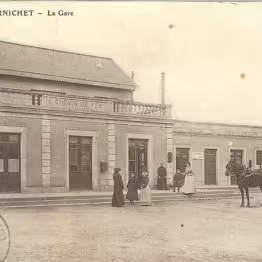
The opening of the Saint-Nazaire–Le Croisic railway line in 1879 accelerated this transformation. Holidaymakers could now arrive by train, in ever-growing numbers. The population expanded rapidly. The salt marshes, gradually abandoned from 1870 onwards, were filled in and drained in 1899. On 9 April 1900, after years of petitions and with nearly 1,200 inhabitants, Pornichet officially became an independent town. The former salt workers’ village entered the 20th century as a town.


The visionaries who shaped the Atlantic seaside town
On 13 May 1900, Pornichet appointed its very first municipal council and elected its first mayor: Charles Mercier, a Parisian lawyer who had worked tirelessly for the independence of the small harbour town. But Mercier did far more than administer. As early as 1886, he designed the Sainte-Marguerite district under a strict development charter, banning shops and casinos to preserve the residential character of the neighbourhood. Just months after the municipality was officially created, the town council approved construction of the public school on what is now Place du Marché, even before establishing a proper town hall.
In 1912, Pornichet adopted its coat of arms and official motto. Beneath the bell tower of the town hall, the municipality’s emblem can still be seen carved in stone: two heraldic dolphins, symbols of vitality, framing the rocky islet of Pierre Percée. The maritime pine pays tribute to Jacques Berthault, who helped secure the dunes. The scallop shells evoke the maritime identity of the town. The motto, Nanti neptunus favet amicus (“Friendly Neptune favours swimmers”), was written by Charles Mercier himself, inspired by the motto of Nantes — a subtle reference to the people of Nantes who played such an important role in the town’s development.
Pornichet has also inspired great writers. Returning from a journey through the Guérande peninsula, author Jules Sandeau set his novel La Roche aux Mouettes around Pierre Percée and even introduced a character named Pornichet. Later, Julien Gracq mentioned Pointe du Bé and the Casino in his Lettrines. Astronomer Camille Flammarion described the phosphorescent sea from these shores. Sarah Bernhardt stayed in Sainte-Marguerite and frequented the Hôtel de l’Océan.

Pornichet through the years
- 1845 – Jacques Yves Berthault acquires the dunes
- 1862 – Building of the first villas
- 1876 – Hôtel des Bains et de la Plage
- 1879 – Arrival of the railway
- 1882 – Grand Hôtel de l’Océan
- 1900 – Birth of the Atlantic seaside town
- 1907 – Creation of the racecourse
- 1912 – Adoption of the coat of arms and motto
- 1922 – Grant of the health resort status
- 1930 – Creation of the seafront boulevard
- 1934 – Marine thermal baths
- 1936 – First campsite
- 1978 – Opening of the deep-water port
- 1996 – Creation of Les Renc’arts festival
- 1998 – New covered market
- 2005 – Quai des Arts cultural centre
- 2011 – Inauguration of the new racecourse
Dive into the heritage of Pornichet
To trace the history, step inside the Heritage House, where documents, photographs and objects bring the town’s memory to life. You can also join the guided tour Walking in the Footsteps of Pornichet’s Founders, tracing the legacy of Jacques Yves Berthault, Louis Flornoy, the pioneering nuns behind thalassotherapy, and the first holidaymakers who shaped the resort.
In 1922, Pornichet was officially recognised health resort, acknowledged for the benefits of its sea baths and salty sea air. During the 1960s, thalassotherapy expanded and the seafront boulevard began to take shape. In 1978, the deep-water marina established Pornichet as the departement’s largest leisure harbour. Each decade added a new layer to the town’s identity, from the covered market inaugurated in 1998 to the Quai des Arts cultural centre opened in 2005.
To discover Pornichet’s Belle Époque villas, their turrets, bay windows and ornate decorative friezes, another chapter now begins.