
4 neighbourhoods, 4 distinct atmospheres
In Pornichet, changing neighbourhood feels like changing mood. Each area has its own name, history and personality. Here, cosmopolitan seaside retreats overlooking the Atlantic; there, a rural hamlet where time once stood still; further on, a railway station that changed everything. You can move from one to the next in just a few minutes, yet the scenery transforms with every step.

Sainte-Marguerite, the cosmopolitan quarter
In 1886, Charles Mercier, a Parisian lawyer and future first mayor of Pornichet, created the Sainte-Marguerite district, named after his daughter. His development rules were strict: no shops, no casino. Peace and tranquillity above all else. Alongside his associates, British businessman Charles Spiers and Belgian entrepreneur Ernest Ortmans, he opened the Hôtel de la Plage in 1895, directly facing the sea. Visitors soon arrived from all over Europe and beyond. British guests, Americans, Count Zeppelin, the exiled Queen Ranavalona III of Madagascar, and actress Sarah Bernhardt, who stayed with her friend Albert Carré, director of the Opéra-Comique.
The area soon featured a tennis court, a nine-hole golf course — the first on the peninsula — as well as the region’s very first yachting club. A 1935 guidebook described the district as “one of the jewels of Pornichet and the Côte d’Amour.” Today, the Hôtel de la Plage has disappeared, but the charm remains. Villas reveal themselves discreetly behind hedges, pine trees soften the sunlight, and the beach continues to welcome visitors for timeless and memorable moments.


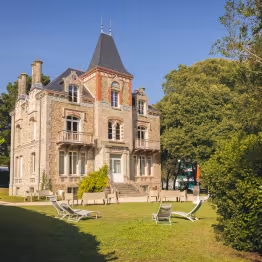

Pointe du Bé, the literary quarter
Pointe du Bé takes its name from the Breton word Beg, meaning “headland”, and already appeared on Cassini maps in the late 18th century. It was here that the first holidaymaking families settled in the mid-19th century, building large residences on the rocks, surrounded by gardens protected by ancient fortifications. During the building of Chalet Plocquin, the remains of a Gallo-Roman villa and pottery were discovered. This place has been inhabited for a very long time.
In 1879, local residents collectively funded the construction of Sainte-Anne Chapel, which was blessed on 24 August that same year. Writer Julien Gracq spent his childhood holidays here in Villa Ker Louisa. In Lettrines, he recalls “the scent of cypress slipping through the darkness” and “the fresh smell of washed pine trees that felt like the very essence of holidays.”
Today, visitors wander through quiet little avenues, catch sight of former oyster beds, step back into the 18th century in front of the old fortifications, and stop to admire the fully restored Château des Tourelles. The peaceful character of the neighbourhood has never changed.


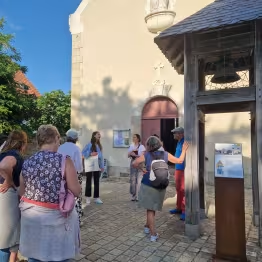
Saint-Sébastien, the original village
Saint-Sébastien is the oldest district in Pornichet. Its name comes from a chapel built in 1491, of which only the pointed arch doorway remains. In 1823, writer Édouard Richer observed that local inhabitants showed “utter bewilderment at the sight of a stranger.” When Maxime Du Camp and Gustave Flaubert traveled through in 1847, they described only “a poor hamlet of twelve cottages.”
This isolated village remained largely self-sufficient until the opening of a local road in 1850. Then holidaymakers travelling toward the sea began passing through. The church, opened for worship in 1868, received its bell tower in 1897. Its impressive size had a reason: at the time, it was the only place of worship between Escoublac and Saint-Nazaire. In 1900, the newly created council of Pornichet settled in the local school building, lacking proper premises. Village life revolved around the grocery store, the blacksmith and Madame Leblais’ refreshment shop, where cyclists would pause after climbing the hill. Today, the growing town has caught up with the original hamlet, but the church and its bell tower still stand watching over Pornichet.


The town centre, full of energy
On 11 May 1879, the Nantes–Le Croisic railway line was officially inaugurated. Originally designed to transport salt and fish, it was quickly overwhelmed by Parisian and Nantes families eager for seaside escapes. Pornichet was now only ten hours from Paris. Steam trains disembarked waves of holidaymakers, accompanied by servants and loads of luggage. At the station, horse-drawn omnibuses and improvised carts crowded together to take visitors to their holiday residences. Musicians welcomed arrivals on the platform — the celebrations began the moment the train pulled in.
Shopkeepers quickly sensed the opportunity and opened businesses around the station, creating a second town centre. Today, the TGV connects Paris to Pornichet in just three hours. The fanfare arrivals may be gone, but the lively atmosphere remains in a vibrant town centre filled with shops, café terraces and cultural life.


Explore Pornichet’s neighbourhoods with a guide
Each neighbourhood reveals even more when shared by those who know its hidden stories. Pornichet’s Belle Époque guided tours take visitors in the footsteps of the holidaymakers, architects and influential figures who helped shape the town.
Surrounded by pine trees, Belle Époque villas, and the ocean, discover the timeless charm of the Sainte-Marguerite neighborhood on a guided tour.

Travel back in time in the Mazy neighborhood and immerse yourself in the Belle Époque, the era when the train first arrived and people began taking their first sea baths in Pornichet.
At sunset, the Pointe du Bé comes into view overlooking the ocean. Amid the villas, the chapel, and the endless horizon, the light gently fades, inviting you to slow down. A moment suspended in time, where Pornichet reveals its story to the rhythm of the…